









|
|
|
|
|
|
A Brief History of Pelješac Peninsula and Janjina |
||||
|
Continuity of human life on Pelješac (Pell-yeh-shatz) can be traced from the Neolithic period till our days. Quite likely, the peninsula was inhabited even in the earlier, Paleolithic, period, but the earliest proofs of human habitation on Pelješac are the Neolithic artifacts, from about the third millennium BC, found in caves between Ponikve and Česvinice, as well as on Mt. Ćućin (above Trstenik), and at Gornja [Upper] Nakovana. Around the 5th century BC, an Illyrian tribe called “Plereians” lived on the peninsula. At that time Illyrians inhabited all the land between the Bay of Kotor (in today’s Montenegro) and the Neretva River. Great number of Illyrian burial places, rocky mounds called “gomile” (Croatian for “mounds” or “piles of rubble”), tell us that the peninsula must have been quite densely populated by the Plereians in the pre-historic times. Despite the presence of Greeks in the immediate vicinity of Pelješac, their contacts with and their influence on the Illyrians of Pelješac, appear to have been insignificant. It seems that Pelješac wasn’t interesting to the Greeks. Towards the end of the 3rd century BC on the shores of ancient Illyricum arrive Romans, with their expansionistic intentions and with the excuse of protecting the Greeks and the maritime trade from the Illyrian piracy. The long resistance of the Illyrians was eventually broken in 35 AD, by barbaric massacre of adult Illyrian male captives, which was carried out by the troops of Ocatvian Augustus, on the islands of Mljet and Korčula. The Romans then sold the Illyrian women and took away their children as slaves. After this, all resistance on Pelješac was crushed and the peninsula eventually became a part of the Roman province of Dalmatia, and thus was incorporated into the Roman state. In the 7th century BC, Slavs settled the eastern shores of the Adriatic. From that time on, until 1333 AD, the peninsula of Pelješac was a part of “Hum” (also called “Zahumlje”) -- an early Slavic territory. In 1333 AD, the Republic of Dubrovnik (initially a City-state) bought the peninsula from Serbian king Dušan and Bosnian *ban Stjepan II Kotromanić. Having obtained Pelješac (or “Stonski Rat”, as the peninsula was called at that time), the government of Dubrovnik started undertaking a string of measures aimed at securing its governance of the newly acquired territory, protecting it from potential invaders and ensuring the liveliness of the local economy. One of those measures was the distribution of land to the new owners. Dubrovnik’s nobility wanted all of the land on the Peninsula, but the resistance of the traditional landowners, especially of the elders, forced them to accept certain compromises.
Janjina (Ya-nye-na)
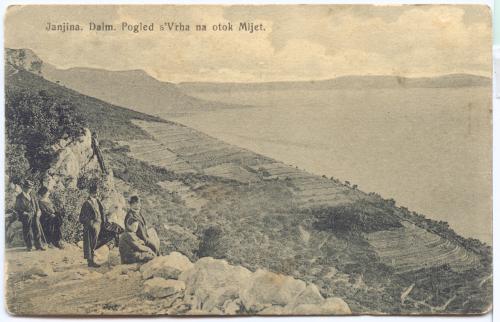
Janjina is a settlement in the middle of the Pelješac Peninsula. It is comprised of Janjina (proper) and a tiny hamlet called Zabreže [Behind Hill] so named because it is “hidden” behind a hill. Janjina is also divided into five parts named: Bara, Jaspričići, Prišlići, Dežulovići and Gornje selo. Gornje selo [Upper Village] is comprised of Lovrovići, Gornje selo (proper) and Polutići. Bara and Gornje selo exist at least since the 4th century AD, while the others are likely to have appeared during 15th or 16th century. There is no reliable explanation about the origin of the name Janjina. According to one opinion, the name is derived from a female personal name “Janja”, because the word Janjina happens to be the possessive case of Janja, meaning “Janja’s”. The oldest document that mentions Janjina dates back to the year 1222 AD. The document records Janjina’s churches of sv. Stjepan [St. Stephen] and sv. Juraj [St. George].
* Ban -- old title for Croatian and Bosnian rulers.
GOVERNMENTAL, MUNICIPAL AND OTHER INSTITUTIONS AND DEVELOPMENT OF JANJINA
Institutions (past and present)Police (“Gendarmerie”) Station opened in 1852.First municipal doctor (G.P.) stationed in Janjina in1863.Post Office opened in 1865.Telegraph introduced 1st April 1871.Port Authority Office opened (at Drače) in1892, closed by 1947.Forestry Office opened in 1905, closed in1914.Roads and Ports (history of development)Between 1808 and1814, under French (Napoleon’s) military authority, the road linking Ston and Orebić was built. This old road, known today as “Kraljev put” [King’s Road], is the first road that went almost the whole lenght of the peninsula.In the year 1820, Janjina-Dol-Rat road, was completed.In 1830, the old Janjina-Drače (via Vardište) road was built.In 1863, Janjina-Popova Luka-Trstenik road was completed.In 1890, the new Janjina-Drače road was built. This road follows more southerly route then the old one.In 1890, Austrian Maritime authority built a warf (the “Old Warf”) for steamships at Drače.In 1894, Capt. S. N. Bjelovučić built a road that follows the shoreline from Drače to Sutvid.In 1910, Janjina’s Main Street was built. It was sealed (concreted) 43 years later, in 1953.In 1937, new shoreline was built in Sreser and a warf for larger vessels.In 1937/38, The Maritime Authority built a warf for large vessels at the Bjelovučić’s mansion in the bay of Sutvid.In 1954, the Putniković-Janjina-Pijavičino road was built. Today it is a part of the Pelješac (Main) Road.
Associations/Institutions (history)
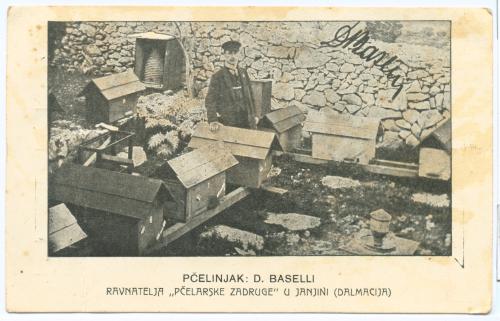
In 1902, Janjina’s Credit Union founded.In 1909, Olive Oil Cooperative founded.In 1910, Bee-keepers Cooperative founded.In 1921, Fishery Cooperative founded. In 1921, Hunters Association founded. In 1924, Winemakers-Grapegrowers Cooperative founded. In 1925, regional branch of Zagreb based “Hrvatski radiša” [Croatian Worker] founded. In 1940, Janjina’s “Consumer-Trade Association” was founded, from which, after the Second World War, the “Agricultural Cooperative of Janjina” was born. In 1942, Fishery Cooperative founded – again. In 1948, the electrification of Janjina, Popova Luka and Sreser was completed. The electrical power came from the diesel-generator housed in the Olive Oil Cooperative building. In 1961, on the initiative of the new socialist government the municipality of Janjina founds the “Naprijed” [Advance] Trading Company, which takes over all of the Agricultural Cooperative’s trading activities. In 1969 the trading company is disbanded and its business is taken over by the trading firms “Budućnost” from Dubrovnik and “Razvitak” from Metković. In 1962, Janjina loses its municipality and its teritory is absorbed in the Municipality of Dubrovnik. In 1963, Janjina’s Tourism Association founded. In 1964, Sreser’s Tourism Association founded.
Schools (history)
In 1828, Janjina gets its first school -- Janjina’s Boy’s Public School. In 1882, the Girl’s Public School opened. In 1920, Sreser gets its co-ed public school. The school closed in 1932 due to insuficient number of children. In 1927, the new (present-day) Public School building was built. In 1928,
“Građanska” [Civic] School of Janjina opened. Closed in 1937 due to insuficient
number of children. In 1932, Janjina gets its “Women’s Training School”, (closed in 1943).
Culture
In 1635, the first statute of Janjina’s Fraternity of St. Stephen was written. In 1848, Croatian National Guard founded in Janjina. In 1893, Janjina’s Public Wellfare Society founded. In 1896, Croatian Cultural-Educational Society “Zvonimir” was founded in Janjina. The society had its Reading Room, the *“Tamburica” orchestra and its amateur theatre section.In 1908, founded “Hrvatski sokol” [Croatian Falcon], a sporting and cultural association. In 1912, the association built its hall “Sokolana” with the stage for performances.In 1912, “Težačka sloga”, (agricultural workers association) founded in Janjina and opened its reading room.1914, musical instruments for Janjina’s “Fanfare” purchased. Fanfare later become Janjina’s brass band.In 1921, Esperanto Club and the singing society “Slava” founded.
In 1924, the
Chess Society founded, with its own library and reading room. Also in the same
year Janjina’s soccer club “Iskra” was founded.
|